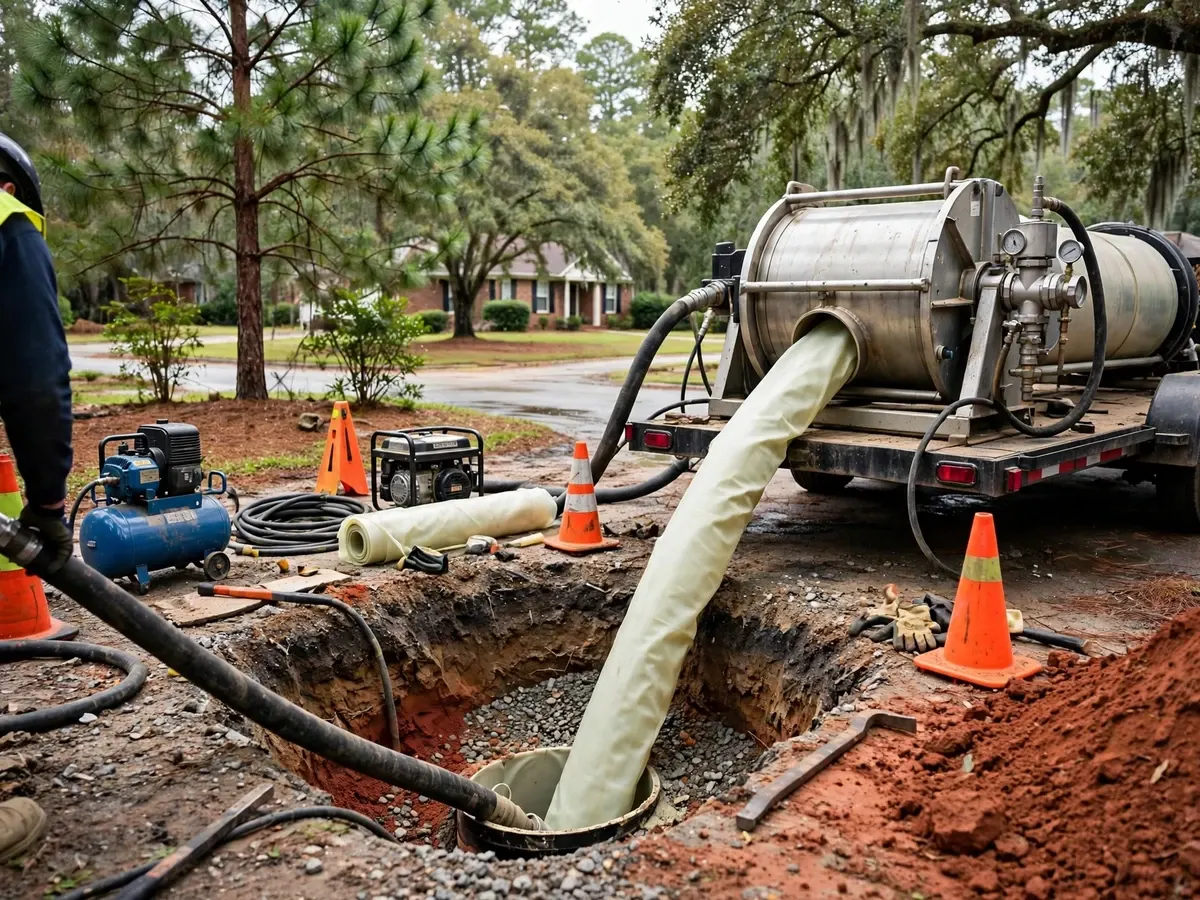
A cracked or rooted sewer pipe used to mean a trench across the yard. Pipe lining offers another path. A resin-soaked liner goes inside the old pipe and hardens into a new pipe within the old one, so most of the work happens through a small access point.
This guide explains how lining works, when it fits and when it does not. The sewer line repair page compares lining with spot repair and replacement, and our plumbers explain which one suits a given camera finding.
How lining works
- 01
Clean the pipe
Roots, scale and debris are removed with a cable or a jetter so the liner can sit tight against the wall.
- 02
Camera check
A camera confirms the pipe is continuous, sized and shaped for a liner.
- 03
Insert the liner
A felt tube coated in epoxy resin is pulled or inverted into the pipe.
- 04
Cure
Steam, hot water or light cures the resin, which takes a few hours.
- 05
Reopen and inspect
Lateral connections are reopened with a cutter and a final camera run records the finished pipe.
The liner seals cracks and joints, and it blocks roots from entering. It leaves a slightly smaller pipe, but its smooth wall usually flows as well as or better than the old pipe.
When lining fits, and when it does not
| Condition | Lining works? | Why |
|---|---|---|
| Cracks and open joints | Yes | The liner seals them |
| Root intrusion at joints | Yes, after cutting roots | The liner blocks new roots |
| Light corrosion or scale | Yes | The liner covers the rough wall |
| Collapsed pipe | No | The liner needs an open path |
| Large bellies or sags | Usually no | A liner follows the low spot and holds water |
| Severe offset joints | Sometimes | Depends on the size of the offset |
A camera inspection decides. The plumber measures pipe size, notes bellies and looks for collapses. If you are weighing options, ask for the video and ask why the plumber recommends lining, bursting or digging.
Questions to ask before you hire
Ask the contractor
- Does the quote include cleaning and a before and after camera video?
- What is the liner material, the length and the warranty?
- How are lateral connections reopened?
- Who pulls the permit and schedules the inspection?
- What happens if the camera finds a collapse mid-pipe?
Lining a pipe with a sag locks the sag in place. Be wary of a quote that skips the camera. A clean, dated video of the finished pipe is your record for resale and insurance.
Cost factors
Price depends on pipe length, diameter, access, the amount of cleaning needed and the number of connections to reopen. Lining a short section costs less than lining a long run, though a long run avoids a long trench. Ask for the price both ways.
A dig is still the right answer for a collapsed or heavily bellied pipe. Our hydro jetting service often comes first to clean the pipe so lining can go ahead.
Before and after: the paperwork to keep
Lining is a quiet repair, so documentation matters. Keep the before video, the cleaning invoice, the liner specification and the after video. Ask for the liner length, thickness and resin type to be written on the invoice, along with the warranty.
If you sell the house later, a buyer's inspector may run a camera through the lateral. Having your own recorded finish and warranty proves that the repair was done and what was done. Store copies in a folder with your home records.
Also note the location of cleanouts and any reopened connections. If a future plumber knows where the liner begins and ends, they can work on the line without surprises. Good records turn a one-time repair into a lasting asset.
Warning signs a liner may be needed
Slow drains that return after cleaning, repeated root cutting and a sewer smell near the yard are all hints. A camera visit turns hints into facts and shows whether the pipe is a candidate for lining or needs a different repair.
Do not wait for a full backup. A pipe with a small crack is far easier to line than one that has collapsed, and a planned repair costs less than an emergency dig in bad weather. Treat a repeated clog as information rather than a nuisance.
The short version
Lining repairs cracks, open joints and root entry without a long trench, but only in a pipe that is open and mostly straight. Get a camera inspection first, ask for the video, compare lining with spot repair and replacement, and confirm what any city program covers before you sign. Keep the before and after footage and the warranty with your home records.